


Tolpyhina® Neuro Lab
boutique neuroscience lab specializing in personalized neurofunctional assessment across brain, body, development, and performance
Beyond diagnosis. Exploring neurofunctional patterns through personalized neuroscience.
QEEG brain mapping, neurotherapy, neurodevelopment, emotional regulation, nervous system restoration and cognitive performance optimization.
Over 15 years of experience working with children, adults, families and human development.
Over 8 years of specialization in QEEG and applied neuroscience.
Thousands of QEEG studies and neurofunctional assessments conducted.
Hi, its Yuliya Tolpyhina. Neurotherapist and Researcher in developmental neuroscience (Israel). QEEG expert. Educator. Entrepreneur. Author.
Specialist in the field of education, child Neurodevelopment and parental counseling; Montessori teacher. One of her main research interests lies in the field of child neurodevelopment, child-parent, family relationships, socio-emotional development, vicarious learning and effective education in the era of globalization, information explosion, rapid changes and conflicts.
Yuliya is the founder and director of Tolpyhina® Neuro Lab, where she conducts QEEG- and ERP-based neurofunctional assessments, developmental neuroscience research, and applied brain-based consulting for children and adults @tolpyhina.neuro.lab. Creator of exclusive BBS Center that works with Brain, Body and Soul Model® (BBS) and includes such services as QEEG, life, parental, family coaching; neurodiagnostics; parental counceling; osteopathy.
She is founder of the innovative bilingual center with an interdisciplinary personalised neuro physiological psychology approach in education My Family Bilingual Center @my_family_center (Ukraine).
The author of the #neuropsychological teaching methodology, based on knowledge of child psychology and the laws of development of the child's body and brain. The author of a unique course for parents #neuropsychologyofparenting, which helps to understand WHY children behave in a certain way at a certain age. Neurolearning shows you how you think and learn, and get you started on the road to a successful future.
I integrate four powerful tools to create a holistic, personalized plan for each client: Neurofeedback, Neurodiagnostics,
QEEG & HRV. Comprehensive Mind-Body Approach. Data-driven therapy. Science-backed methods. Personalized support for children, adults, and families.
Tolpyhina® Neuro Lab develops integrated neurofunctional profiles for children and adults, combining EEG/qEEG, ERP, HRV, reflexes, motor and sensory assessment, developmental history, and physiological markers to support early intervention, personalized planning, progress tracking, and nervous system optimization.
1. QEEG — Brain Mapping
We start with a detailed brain map to identify patterns of overactivity, underactivity, or imbalance.
Outcome: A clear, individualized neurofeedback protocol tailored to your needs.
2. Neuropsychophysiological asessment - development of reflexes, social-emotional, cognitive and motor development,
attention, memory, perception.
Outcome: understanding the strengths and weaknesses in the child's development, adaptation of development, training, education, providing the child with the maximum possible potential.
3. Neurofeedback — Brain Training in Real Time
We train the brain to self-regulate by providing live feedback using audio or visual cues. The brain learns to optimize its
own activity — gently and naturally.
Outcome: Improved sleep, reduced anxiety, better focus and emotional stability — without medication.
4. HRV — Tracking Nervous System Health
Heart Rate Variability (HRV) is a key indicator of your body’s stress and recovery balance. We use HRV to monitor nervous system responses and support home-based breathwork and self-regulation practices.
Outcome: Greater resilience, energy, calm, and insight into your stress patterns.
Children & Teens: Improve attention, memory, and learning. Reduce irritability and anxiety. Support with ADHD, sleep issues, and emotional regulation.
Families: Strengthen emotional stability and communication. Heal after stress or trauma. Create more calm and connection at home
Adults: Build focus and mental clarity. Recover from burnout, fatigue, and chronic stress. Support with anxiety, depression, and insomnia.
Learning & Work Performance: Boost productivity and creativity. Improve recovery from pressure and overload. Sharpen mental agility and resilience.
Why It Works: Fully personalized based on brain & body data. Evidence-based, safe, and non-invasive methods. Objective progress tracking. Builds long-term skills in self-regulation. Integrates the brain, body, and emotional system in one process
In addition to personal consultations, I organize and conduct group trainings, seminars and webinars. I act as an expert and coach for parents, teachers, heads of children's institutions, educators, grandparents, nannies and children. I advise managers of various children's areas (schools, kindergartens, development centers, publishing houses, manufacturers of clothes, toys, etc.).
I strongly believe it is better to look for the CAUSE in everything and work with it, rather than fight with the EFFECTS.
I am also the mother of four beloved bilingual girls. Therefore, I understand and see the problems of development, education and training not only as a specialist, but also as a mother. Can explain complex things simply.
Each consultation is customized to the demands, needs and strategy of an individual.
The difference that I bring is my ability to ask you questions that you do not always wish to ask yourself. But later on you are challenged to answer them in detail and open up a new perspective.
Children & Teens. Helping neurodivergent, gifted, and sensitive children reach their full potential
• ADHD / ASD patterns of brain activity support through neurofeedback & qEEG
• Emotional regulation & developmental coaching
• Neurodiagnostic based personalized developmental and educational plans
Adults and Parents. Empower your brain to work with you, not against you
• Brain performance coaching (focus, memory, resilience)
• Burnout recovery
• qEEG-based cognitive optimization
• Emotional self-regulation with neurofeedback
• Parent consulting & neuroplasticity-based guidance
Leaders & Organizations. Neuroscience-backed tools for conscious leadership & team intelligence
• Executive qEEG scans (resilience, emotional patterns)
• Workshops on stress regulation and high-performance flow
• Strategic consultations using brain-based models for growth and empathy
Services. Tailored, science-backed support for minds at every stage
• qEEG Brain Mapping & Functional Reports
• Neurofeedback (NeurOptimal or protocol-based)
• Personalized Development Plans
• Biofeedback, HRV, Mindfulness Tools
• Family & Business Coaching
I am also a mom of 4 girls, so I know you concerns and worries not only like a specialist, but also like a parent.
In order to become a high-class professional in my field, I studied and continue to study with the best specialists in America, England, Holland, Germany, France, Canada, Ukraine, IsraelReady to begin? Book a consultation or an educational event for your organization and take your first step toward clarity, calm, and confidence. Professional guidance. Personal attention. Measurable results.
An individual approach — protocols based on QEEG and HRV. Only scientifically proven methods. Objective progress metrics. Skills that last a lifetime. Comprehensive work with both the body and the brain simultaneously.

Tolpyhina Neuro Lab has developed a unique brain-based approach designed to help identify potential root causes of ADHD, autism, dyslexia, learning and behavioral challenges, depression, anxiety, PTSD, traumatic brain injury (TBI), addiction, memory difficulties, and more.
Our goal is to support optimal mental, emotional, and cognitive functioning, especially at times when peak performance is essential for you and those you support.
Over the years, we have built an extensive database of brain QEEG recordings related to emotional, learning, and behavioral patterns. Individuals from around the world have benefited from our work across a wide range of challenges.
With more than 10 years of experience and thousands of QEEG brain assessments, we bring deep expertise to the interpretation of brain activity and neurofunctional patterns.
SCIENTIFIC WORK and EXPERIENCE:
Yulia not only works with children in functional neuroasessment practice, but has also been actively engaged in scientific research in the field of brain development and EEG in Israel for the past 4.5 years.
This means that her work is grounded not only in practical experience, but also in scientific data derived from studies she personally conducts and publishes in international peer-reviewed journals as part of her academic work.
Yuliya began conducting scientific research in 2022 at Ariel University (Israel), where she focused on early brain development using electroencephalography (EEG).
In 2024, she continued her research at the Hebrew University of Jerusalem.
Due to the transition between academic programs and institutions, she completed additional advanced training, including 18 academic credits in social work and developmental neuroscience.
This training took place at the Edmond and Lily Safra Center for Brain Sciences - one of the leading neuroscience research centers in the world.
As part of her academic training, Yuliya studied:
-
systems neuroscience
-
cognitive neuroscience
-
neurobiology (from molecular mechanisms to neural networks)
-
neuroimaging methods (MRI, fMRI)
-
electroencephalography (EEG)
-
behavioral neuroscience
This education included not only theoretical training but also hands-on work in leading research laboratories, including MRI, FMRI, EEG labs, brain dissection under the supervision of internationally recognized experts.
Such a multidisciplinary background allows her to combine practical work with children with a deep understanding of how the brain develops and functions.
Yuliya’s scientific work focuses on understanding how environmental factors influence brain development, behavior, and developmental trajectories in children.
In both her research and private practice, she uses EEG, QEEG, and HRV to investigate the neural mechanisms underlying social, emotional, and cognitive development.
📄 How Parental Relationships Shape Child Brain Development (2024). Published in Frontiers in Psychology.
In this study, I examined how interactions between parents influence infant brain development.
We tested for the first time whether a child's brain can develop not only through direct interaction, but also through observing the relationship between parents - that is, through so-called "vicarious" experience.
Using EEG, we measured infant brain activity and found that the more a child observed positive interactions between mother and father, the more pronounced their left-frontal alpha activity—a marker associated with adaptive social and emotional development.
Importantly, this effect persisted even after accounting for other factors. This means that positive parental relationships themselves play a significant role in a child's brain development. This study demonstrates the long-term influence of the family environment on a child's brain development.
📄 Research under review (the article is under consideration in an international scientific journal)
In this study, I went further and examined not only the overall influence of the environment, but also how the child's brain reacts directly at the moment of parental interaction.
We used three conditions: a calm baseline condition, positive interaction between parents, and neutral presence of parents without interaction.
Using EEG, we compared how the child's brain activity changed in each of these states.
We have seen that positive interactions between parents immediately change the child's brain activity—the child literally begins to respond and "switch on" at the level of neural processes.
These changes differ from the baseline state and indicate that the child's brain is actively processing observed interactions between adults in real time.
The key difference: While the first study shows how the family environment influences brain development as a whole, the second examines how the child's brain responds to these interactions here and now.
📄 I am now pursuing a broader line of research on how the environment influences a child's brain development.
Unlike the classic approach, which focuses solely on interactions with parents, this project considers the child's extended environment, including grandparents, siblings, pets, daycares and other social contexts, as well as factors such as screen time.
Using EEG, I explore how all of these elements together influence the development and functioning of a child's brain at an early age.
📄 Upcoming study (recruitment will open soon)
A new study involving children aged 6–7 years is planned to be launched in the coming months.
In this project, we will study brain development, the characteristics of social information processing, and various aspects of empathy.
The study will include both EEG and additional methods to provide a deeper understanding of how social and emotional processes develop in older age.
This project also plans to recruit participants, which I will inform you about later.
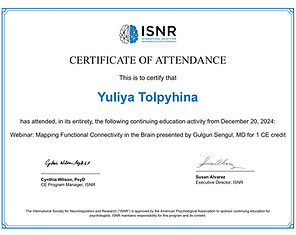
DIPLOMAS AND CERTIFICATES

.jpeg)


.jpeg)







Brain Body Soul Model: From DNA to Behavior.
Level 1 DNA / RNA / Proteins: The foundation. Genetic code, epigenetics, nutrient support, mitochondrial health. Interventions: genetic counseling, organic acid testing, detox support, nutrition (Omega-3, B vitamins, zinc, magnesium, vitamin D), sleep regulation, LLLT therapy.
Level 2 Pathways and Synapses: Neurotransmitters (dopamine, serotonin, noradrenaline, glutamate, GABA) transmit signals between neurons. Imbalances lead to attention dysregulation, anxiety, impulsivity. Interventions: neurotransmitter metabolite analysis, Braverman test, amino acids, vitamins, diet, psycho-emotional practices, LLLT, HRV training, physical activity, pharmacotherapy.
Level 3 Networks and Brain Structures: Sensory integration? the brain collects, organizes, and interprets signals from the senses. Interventions: sensory integration therapy, binocular vision development, auditory-speech perception exercises, movement therapy, primitive reflex integration, osteopathy.
Level 4 Systems (Brain Region Interaction): The brain unifies sensory signals, memory, emotions, and motor functions into coordinated networks. Interventions: QEEG and neurofeedback, HRV and breathing practices, neurocorrection, cognitive-behavioral therapy, play and art therapy.
Level 5 Behavior (Phenotype): Behavior is the external manifestation of internal neurophysiological and sensory organization. We don't "treat" behavior, we work comprehensively with the system that caused such behavior. Interventions: functional neurodiagnostics (QEEG, HRV, sensory profile), neurotherapy, family support, individualized development programs, parent education.

Level
DNA / RNA / Proteins


Level
Pathways and Synapses


At this level, the most fundamental biological mechanisms are at work. DNA (the genetic code inherited from our parents) contains instructions for all functions of the body, RNA transfers these instructions, and proteins carry out the work by building tissues, transmitting signals, and regulating cellular activity. Together, these processes form the foundation for how brain cells develop and interact.
DNA can be thought of as a book of "recipes" or instructions containing all the possible proteins and enzymes the body may need. These instructions influence how the brain develops, how the immune and endocrine systems function, and how the body responds to stress, nutrition, or learning.
RNA acts like a messenger or chef that "reads" the relevant recipe from DNA and carries it to the molecular factory, the ribosome, where proteins are produced according to these instructions.
Proteins perform most of the work within cells. They create structure (e.g., cell membranes and receptors), transport substances, transmit signals between cells, regulate gene activity, and initiate chemical reactions.
If errors occur at this level because of genetic mutations, epigenetic disruptions, or insufficient building materials such as amino acids or vitamins, brain and body cells may not function optimally. This can contribute to neurotransmitter imbalances, metabolic dysfunction, mood instability, and other challenges. Disruptions at this level may be inherited or influenced by environmental factors, including nutrition, toxins, or maternal stress during pregnancy.
Even when genes themselves are intact, their expression may become altered. This process is known as epigenetics. For example, chronic stress may not only affect neurotransmitter activity but can also literally "switch off" genes involved in emotional regulation and neuroplasticity. This occurs through epigenetic modifications, which are chemical markers that influence whether certain sections of DNA are read or suppressed.
For example, during prolonged stress, levels of cortisol increase. Elevated cortisol may suppress genes associated with dopamine and serotonin receptors, reducing the brain’s ability to regulate emotions, cope with anxiety, and experience reward or pleasure.
Stress may also downregulate genes involved in neuronal growth and repair, such as BDNF (brain-derived neurotrophic factor), which can negatively affect memory, learning, and neuroplasticity.
If such epigenetic patterns persist over long periods, especially during early development, they may influence physiology for years to come. The encouraging news is that many epigenetic changes are potentially modifiable through lifestyle, nutrition, sleep restoration, stress reduction, and supportive environments.
Possible interventions and support strategies:
Genetic consultation. Examples include assessment of polymorphisms such as COMT, MTHFR, MAOA, and others. These may help identify genetic tendencies influencing neurotransmitter metabolism, detoxification, and stress regulation.
Organic acids testing (urinary organic acids). This type of assessment may provide insight into functional metabolic patterns and help evaluate: cellular energy production, detoxification pathways, neurotransmitter metabolism, vitamin and antioxidant, deficiencies, oxidative stress, mitochondrial function, overgrowth of certain intestinal microorganisms. Children born with inherited organic acid metabolism disorders may have difficulty eliminating specific metabolic byproducts from the blood.
Supporting detoxification and mitochondrial function. Approaches may include nutritional and lifestyle strategies aimed at supporting mitochondrial energy production, antioxidant defense, and detoxification processes.
Nutrition. Adequate intake of Omega-3 fatty acids, B vitamins, zinc, magnesium, and vitamin D is important for neurotransmitter synthesis and proper protein function. A nutrient-rich, anti-inflammatory diet with minimal ultra-processed foods may help support brain and nervous system functioning.
Sleep and circadian regulation. During sleep, genes involved in tissue repair, immune regulation, and nervous system restoration become more active. Healthy sleep may therefore play a critical role in supporting molecular and neurological processes.
Epigenetic support. Potential supportive factors include stress reduction, safe and predictable environments, body-based practices reducing toxic load (e.g., heavy metals or excessive sugar), adequate methyl donors such as folate and vitamin B12, choline, zinc.
LLLT (Low-Level Laser Therapy). Low-level laser therapy has been proposed to influence mitochondrial activity and cellular energy production.
If the mother’s or child’s body does not receive essential nutrients, or if harmful environmental factors affect gene expression, brain development may begin along a less optimal trajectory from the earliest stages. It is similar to building a house on an unstable foundation.
This is why the earliest stages of brain and nervous system development are so important. Understanding this level helps illustrate how even subtle molecular changes may contribute to significant cognitive, emotional, or behavioral differences later in life, and why a multilevel, integrative approach may be valuable when considering human development and functioning.
What is happening:
At this level, chemical messengers — neurotransmitters such as dopamine, serotonin, norepinephrine, glutamate, and GABA — are at work. They transmit signals between neurons through synapses. The balance and activity of these substances determine how effectively the brain regulates excitation and inhibition, attention, motivation, mood, and behavior.
Why it matters: Even if brain cells are structurally intact, disruptions in chemical signaling (for example, dopamine deficiency or an imbalance between GABA and glutamate) can lead to dysregulation of attention, anxiety, impulsivity, and mood instability. This is commonly observed in conditions such as ADHD, autism, depression, and anxiety disorders.
Possible interventions include neurotransmitter metabolite testing in urine or blood, which provides insight into the biochemical “state of the brain.” This laboratory assessment measures the breakdown products of neurotransmitters (such as dopamine, serotonin, norepinephrine, and GABA). Their levels can indicate excess, deficiency, or impaired metabolism of these essential chemical messengers. These substances play a critical role in regulating mood, motivation, sleep, stress response, and attention. This approach offers an objective picture beyond observations and reported symptoms, helps personalize interventions by guiding the selection of appropriate amino acids, vitamins, dietary strategies, or psychotherapeutic approaches, allows monitoring of treatment effectiveness, and reduces trial-and-error in selecting medications or nutraceuticals.
The Braverman Test may also be used as an additional assessment tool.
Based on the results, interventions may include amino acids (such as tyrosine, tryptophan, and 5-HTP), which serve as building blocks for neurotransmitters; vitamins and minerals (including vitamin B6, magnesium, zinc, and omega-3 fatty acids); dietary adjustments (for example, increasing protein intake in the morning and reducing sugar consumption); psycho-emotional practices such as breathing techniques and body-based therapies; LLLT or HRV training; and physical activity, particularly aerobic exercise, which supports the release of dopamine and serotonin.
Pharmacological treatment may also be considered when indicated — including stimulants, antidepressants, or anxiolytics — strictly based on individualized recommendations from a qualified healthcare provider.
Neurotransmitters can be understood as the brain’s “electrical switches.” When they are not functioning in harmony, signals may either be lost or become overloaded. Optimizing this level helps the brain return to stable, flexible, and efficient functioning.
Level
Networks and Network Structures of the Brain


What is happening:
Sensory integration is the process by which the brain collects, organizes, and interprets signals from the sensory systems — including vision, hearing, touch, balance (vestibular system), body awareness (proprioception), interoception, and others. This forms the foundation for spatial orientation, a sense of safety, and the ability to self-regulate.
If a child processes sensory information inaccurately (for example, is hypersensitive to sounds or does not adequately feel their body in space), they may experience constant stress. Their behavior may appear as disobedience, while in reality it is a response to sensory overload or disorientation.
Possible interventions include sensory integration therapy (SI therapy), which helps the brain learn to process sensory input more effectively. This approach involves structured activities using specialized equipment such as swings, balls, tunnels, and other tools. Additional interventions include the development of binocular vision, eye movement exercises, and visual-based games, as well as work on auditory processing and speech development.
Movement-based therapies are also important, including yoga, neuromotor therapy, and balance exercises that support the development of the vestibular and proprioceptive systems. Integration of primitive reflexes is another key component, as many perceptual and behavioral challenges are associated with retained early motor patterns (such as the Moro reflex, ATNR, STNR, and others).
Osteopathy may be used to restore balance within the nervous system and relieve tension and restrictions in the body.
If a child does not adequately sense their body or if their sensory system is overloaded, they may present as anxious, impulsive, or, conversely, slowed and withdrawn. In such cases, behavior is not a conscious choice but a signal for help.
At this level, the brain integrates sensory input, memory, emotions, and motor functions into coordinated networks. Different brain regions function as a unified system: the visual cortex interacts with frontal areas, emotional centers connect with motor regions, and so on. This is where more complex cognitive functions are formed, including attention, planning, and social interaction.
When brain networks are not working in coordination, this may manifest as attention difficulties, reduced self-regulation, emotional outbursts, and challenges in communication. A child may appear distracted or difficult, but in reality, their brain is struggling to synchronize these processes.
Possible interventions include QEEG and neurofeedback, which help identify imbalances in brain activity (such as hyperactivity in frontal regions or underactivity in temporal areas) and train better coordination between networks. Brain oscillations (alpha, beta, theta rhythms) and their ratios provide insight into how effectively these networks are functioning.
HRV training and breathing practices help regulate the autonomic nervous system and support synchronization of brain networks. Neurocorrection involves individualized programs combining motor and cognitive exercises designed to improve integration and coordination. Cognitive-behavioral therapy and attention training help develop neural networks related to self-regulation, planning, and reflective thinking.
Play therapy and art therapy activate multiple brain regions simultaneously and support integration between the hemispheres.
Coordinated brain network function is the foundation of stable behavior and adaptive capacity. Disruptions at this level are like an orchestra in which each musician plays independently without a conductor. Behavior becomes disorganized not because of the child’s intent, but due to a lack of coordination within neural networks. When these networks are out of sync, the ability to regulate emotions and behavior is compromised.
Level
Systems
(Interaction of brain regions)


Level
Behavior (phenotype)

What we observe: Behavior and learning as the tip of the iceberg
Behavior is the external expression of internal neurophysiological and sensory organization. It is what parents, educators, and society observe. It includes emotions, reactivity, impulsivity, aggression, social interaction, initiative, and motivation. Behavior is the result of all underlying levels — from genetics to electrophysiology. When a child “misbehaves” or experiences learning difficulties, it is not always a matter of choice, poor parenting, or personality. It may be the result of sensory overload, imbalance in brain rhythms, immature neural networks, or a lack of essential nutrients. Behavior is often a signal for help from a system that is overwhelmed or lacks the necessary resources for adaptation.
Possible interventions include functional and neurodiagnostics (such as QEEG, HRV, and sensory profiling), which help reveal what lies beneath observable behavior. Neurotherapy and family support are also essential, as behavior is influenced by relationships; strengthening attachment, restoring emotional safety, and building understanding play a critical role.
An individualized program for development or correction can be designed based on data from all levels, including nutrition, sleep, movement, neurofeedback, sensory integration therapy, and neurocorrection. Parent education is equally important, helping caregivers understand that behavior is a symptom rather than the primary target of intervention. When parents begin to see the “submerged part of the iceberg,” they shift from punishment to support.
We don't "treat" behavior or external symptoms; we work holistically with the system that causes this behavior, learning difficulties, and interactions. Behavior is a mirror through which we can see what needs help: the body, the brain, sensory integration, and safety. An interdisciplinary approach is the only way to get a holistic picture and create lasting change. After all, every child is a complex system in which biology, experience, environment, and emotional connections interact. To understand and help a child, we need to be able to read this system at all levels. Behavior is only a symptom. And true help begins when we see more than just the external reaction, but the underlying causes. We diagnose at all levels—from neural networks to sensory integration and brain rhythms. And we help the child holistically, respecting their biology, characteristics, and needs. This is the path from observation to deep understanding, from reaction to professional support.


BRAIN.BODY. SOUL. A MODEL OF COMPREHENSIVE DEVELOPMENT
Child and human development is a complex, multi-layered process that begins long before a child takes their first steps or speaks their first words. From birth and even earlier, during the prenatal period the brain begins forming neural pathways that underpin movement, speech, attention, emotions, and the ability to learn. Many parents and professionals are used to observing development from the surface level, focusing on behavior, speech, and academic skills. However, these are only the tip of the iceberg. Beneath them lies a powerful foundation — reflexes, sensory systems, and neuromotor development — upon which all higher brain functions depend.
When a child or adult experiences difficulties — whether related to attention, anxiety, hyperactivity, speech delays, or learning challenges — the root cause often lies not in behavior itself, but in the immaturity of neural networks. If one of the early stages of development has not been fully completed, the brain compensates by relying on other structures. This creates additional load, leads to fatigue, and reduces concentration and emotional stability.
This is why my diagnostic approach focuses not only on symptoms, but also on the foundational levels of nervous system development. It becomes the key to truly understanding the causes of developmental challenges in both children and adults. This is a deep analysis that reveals not only what is happening, but why it is happening. Such a diagnostic system allows us to trace the entire developmental chain of the nervous system — from automatic bodily responses to higher executive functions, from primitive reflexes to cognitive abilities, from early infant reflex patterns to the capacity for thinking, planning, adapting, and self-regulation. Before working with reflex integration and motor development in rehabilitation, it is essential to ensure that the brain has sufficient energy and that inflammation is reduced. Without this foundation, any exercises, rehabilitation, or developmental work may be significantly less effective.
Using advanced equipment and technologies in our research laboratory, we assess the extent to which primitive reflexes are integrated (such as Moro, Galant, sucking reflex, and others), how well sensory and motor systems are developed (including neurovisual functions such as saccades, fixation, smooth pursuit, convergence, dynamic vision, as well as auditory, vestibular, proprioceptive, and tactile systems), how coordinated the motor and postural foundation is and whether postural reflexes are established, the level of maturity of speech, emotional, and social domains, and the development of attention, memory, self-regulation, and learning skills.
This comprehensive diagnostic assessment, together with QEEG, takes approximately 4–5 hours and provides a multi-layered understanding of the child’s brain and body. It is not simply testing — it is the creation of an individual neuroprofile that reveals how the brain functions from within.
To further understand brain function at the level of electrical activity, we complement the assessment with QEEG (quantitative electroencephalography) — a “map of the brain.” QEEG allows us to evaluate the balance between the left and right hemispheres, the activity of specific regions responsible for speech, attention, memory, and emotions, the presence of overactivation or underactivation, and potential biomarkers associated with conditions such as anxiety, ADHD, PTSD, depression, developmental delays, insomnia, and others.


By combining developmental neurophysiological diagnostics and QEEG mapping, we gain the most comprehensive understanding of how the brain—and body, psyche, and emotions—work.
Neurodiagnostics shows how connections and functions were formed.
QEEG reveals how the brain functions right now
HRV shows the balance of the sympathetic and parasympathetic systems.
Together, they create a unique map of a person's neuroprofile: from structure to dynamics, from roots to peaks. This comprehensive approach helps:
- accurately determine the source of difficulties,
- select a personal correction plan,
- enhance the brain's natural resources and discover talents
- create a basis for sustainable development and balance.
Such comprehensive interdisciplinary diagnostics are rare even on a global scale. Only a handful of specialists on the planet combine these approaches—deep somatic-neurophysiological assessment and QEEG analysis of brain activity. This is not just a study, but a powerful tool for understanding personality, potential, effectiveness, and paths to correction. It helps not only children but also adults who have experienced stress, trauma, depression, or overload to restore balance between the body, emotions, and thinking.
If you feel your child (or yourself) is experiencing difficulties with attention, learning, emotions, or behavior, start with a diagnosis that will provide answers, not assumptions. Schedule a comprehensive neurodiagnostic assessment and QEEG mapping and get a complete picture of how the brain works.
We will help you understand the cause, see the potential, and build a path to harmony and development.

CONTACT ME
Do you have questions or suggestions? Would you like to book a seminar for yourself or your organization? Contact us to learn more.
