


INTEGRATION OF REFLEXES + NEUROVISSION + Cranial Nerves
and their impact on development, learning, behavior, socialization, motivation, confidence, effectiveness
TWO MONTHS THAT WILL CHANGE YOUR PRACTICE AND GIVE YOU AN UNDERSTANDING OF THE NEUROLOGY OF MOVEMENT AND DEVELOPMENT

OSTEOPATHISTS, KINESIOLOGISTS, REHABILITATION SPECIALISTS, MASSAGE THERAPISTS,
DOULAM,
GV CONSULTANTS
TO THE COACHES

NEUROLOGISTS, PEDIATRICIANS,
TO THE DIRECTORS OF CHILDREN'S CENTERS, SCHOOLS, KINDERGARTENS, AND CORRECTIONAL CENTERS
TO PARENTS,
NANNIES,
FOR GRANDMOTHERS
to all who participate in the upbringing and development of children

SPEECH THERAPISTS,
TO TEACHERS, EDUCATIONAL TEACHER, COACHES,
CHILD PSYCHOLOGISTS,
NEUROPSYCHOLOGISTS

When a child is born, especially through natural vaginal delivery, a wide range of primary (primitive) reflexes and neural programs are activated within the nervous system. These reflexes are built-in mechanisms that help the child survive, adapt, and develop after birth.
The process of birth itself is a powerful source of physical and sensory stimulation. It acts as a “trigger” for activating primitive reflexes. As the baby moves through the birth canal, pressure on the skull, spine, and body sends a large amount of proprioceptive and vestibular input (sensations of movement and body position) to the brain. This activates reflexes that help the baby begin breathing, seek the breast, regulate body temperature — in other words, support survival.
Below are several key reflexes often discussed by specialists:
Moro Reflex (“startle reflex”)
This reflex is triggered by sudden changes such as loud sounds, abrupt movements, or the sensation of falling. During birth, changes in pressure, light, and sound activate the Moro reflex. It plays a crucial role in initiating the first breath, expanding the lungs and oxygenating the brain. If the Moro reflex is not properly activated (for example, in cesarean section births), it may remain retained and later present as hypersensitivity, anxiety, and difficulties with stress regulation.
Spinal Galant Reflex
This reflex helps the baby move through the birth canal. It is activated by light stimulation along the sides of the spine (approximately 1 cm from the spinal column). During natural birth, rotational movements and pressure stimulate this reflex. It is important for hip movement, crawling, and later walking. If not properly integrated, it may be associated with issues such as enuresis, poor posture, or hyperactivity.
Tonic Labyrinthine Reflex (TLR)
This reflex represents the body’s response to the position of the head relative to gravity. During birth, the vestibular system receives strong stimulation, activating the TLR. If integration is incomplete, it may lead to difficulties with balance, coordination, and fear of movement. Children with retained TLR often dislike tummy time.
Asymmetrical Tonic Neck Reflex (ATNR)
Often called the “fencing posture,” this reflex occurs when turning the head causes one arm and leg to extend while the opposite side flexes. Rotational movements during birth activate this reflex. It is essential for eye–hand coordination and crossing the midline. If integration is delayed, it may lead to difficulties with writing, reading, and sports.
Why the birth process is so important for brain development:
Birth activates the vestibular, proprioceptive, tactile, and autonomic nervous systems. This creates the foundation for self-regulation, motor development, and emotional stability.
When birth is highly medicalized (cesarean section, forceps, vacuum extraction) or traumatic (very fast, very prolonged, cord complications, induced labor), the child may require additional neurodevelopmental support.
Children born via C-section, vacuum, or forceps may not receive the necessary mechanical stimulation that occurs during passage through the birth canal. As a result, many reflexes may be weakly activated or delayed.
These children often benefit from additional sensory and motor stimulation (such as movement therapy, sensory integration, osteopathy) to support proper nervous system development. Without this support, challenges may arise, including low muscle tone, delayed motor development, sensory hypersensitivity, and difficulties with emotional regulation. Over time, retained primitive reflexes can impact learning, behavior, and overall development.
The good news is that we can learn to recognize these challenges early and support children effectively.
How? I invite you to learn more in the course.



WHAT IS THIS COURSE ABOUT AND WHO IS IT FOR?
When a child has certain imbalances and immaturities in their body, this can prevent them from reaching their full potential. The good news is that many of the root causes of conditions such as behavioral difficulties, attention deficit disorder, ADHD, lack of motivation, learning disabilities, and trauma recovery are treatable.
This is one in a series of courses that will teach you how to work with primitive reflexes and improve the quality of life of your patients, children, and even adults.
The development of primitive reflexes is vital for normal neurological development and functioning. However, by the first year of life, they must be replaced by more mature postural responses and motor skills. This often fails for various reasons and impacts learning, behavior, motivation, and even the child's health.
In this course, we talk in detail about each reflex, how to test them, and how to integrate them into your practice.
The goal of this program is to establish appropriate foundational development and organize effective recovery from injury, necessary for the development of learning, attention, behavior regulation, motor skills, balance and eye tracking.
The course offers more than just a set of exercises, but a deep dive into each reflex. This allows you to develop an effective program for development, rehabilitation, correction, and restructuring of your brain.
The course was developed in collaboration with leading Israeli osteopath Kirill Pakhomov @brain_body_soul_, allowing osteopaths and kinesiologists to expand their practice and provide comprehensive support to children and adults.
In this course you will learn KEY THINGS IN BRAIN DEVELOPMENT AND PHYSIOLOGY that many modern children are missing.
1. How does the brain work and develop? How are vital skills for development and learning formed? The connection between the child and adult brain. The connection between movement and cognitive abilities. Motor development. Cranial nerves. Factors that hinder child development.
2. What are primitive reflexes? How to quickly test and integrate them: Moro reflex, sucking reflex, ATNR, SSTNR, Babinski reflex, Galant reflex, tonic reflex, searching reflex, Moro reflex, grasping reflex, and others. We'll also look at SIPVR.
3. How to improve the function of the center of balance, slowed down by primitive reflexes
4. Neurovision. How to test and improve gaze tracking skills that are inhibited by primitive reflexes. NEW: Diagnostic programs and applications.
5. Cranial Nerves: How to use exercises and multisensory stimulation to improve these neurological systems and overall brain and body function.
6. Various dietary and nutritional recommendations that will help you get rid of primitive reflexes faster.
7. Interhemispheric asymmetries. Testing. Correction.
8. How to combine all the information obtained, apply it practically to a specific child or adult, create an action plan and a set of effective techniques to help each person develop effectively, recover from injury, and improve their quality of life!
Reflex checklists. Development checklists.
Exercise checklists. (Russian, English and Ukrainian options)
Integration of reflexes
The online course lasts for two months, during which you will be able to completely transform the trajectory of your practice and your life.
The course consists of pre-recorded video lessons that are released at the beginning of each week, along with homework assignments focused on understanding brain function, the nervous system, and the physiology of development in both children and adults — the foundation that shapes the adult brain. You may also complete the course at your own accelerated pace.
Pricing
Listener format (self-paced, recordings only):
Access to all recorded materials without support, Q&A sessions, or practical training — $500
You can join at any time throughout the year.
Full course with 2-month support and certification:
Includes guidance, support, and certificate upon completion — $1,000
At the end of the course, there will be a live Zoom Q&A session with Yulia Tolpyhina, where she will answer your questions, as well as a practical session focused on your real cases.
If you initially enroll in the listener format and later decide to upgrade to the full program with support and practice, you can complete the second payment.
Upcoming Course Dates
October 4, 2025 — Online course
December — Q&A sessions and practical training
May 2026 Online course
July Q&A sessions and practical training
Individual mentorship (independent of course start dates):
$2,550
The “Reflexes” course is ideally combined with the course “Innovations. Neuro”
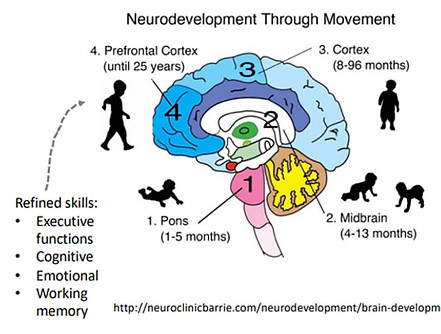
The first years of life are a critical period for brain development. During this time, complex and precisely coordinated processes of brain maturation take place, including the development of neurons, neural connections, synapses, and the formation of the myelin sheath around neurons, which enables faster signal transmission.
Brain development begins with the lower brain structures — the brainstem (pons and midbrain) — followed by the maturation of the cortex and, later, the prefrontal cortex. Movement and experience play a key role in stimulating this growth.
-
Pons (0–5 months) — responsible for basic reflexes
-
Midbrain (4–13 months) — movement and sensory integration
-
Cortex (8–96 months) — speech and perception
-
Prefrontal cortex (up to 25 years) — regulation, thinking, and emotional control
After birth, the brain enters a phase known as synaptic proliferation — a rapid expansion of connections between already formed neurons. This stage lays the foundation for how the brain will function throughout life. If you compare the brains of a newborn, a two-year-old, and a six-year-old, you can see that no other period in life matches the intensity of early brain development and the formation of neural connections. This is why the early years are so important. The richer a child’s experiences and movements, the stronger and more reliable these connections become.
Following this phase, the brain begins a process called synaptic pruning — the elimination of unnecessary connections. Frequently used and functional synapses are preserved, while inactive ones are removed. This principle is often described as: “use it or lose it.”
Neuroplasticity — the brain’s ability to change, adapt, compensate, and form new connections — remains throughout life, but its intensity is highest during early development.
Myelination is the process by which a fatty layer forms around neurons, allowing faster transmission of signals in the brain. This process is especially active in early childhood and is strongly influenced by dietary fats. The brain requires both fats and proteins for the development of cells and neural structures.
Movement, breastfeeding, and nutrition rich in healthy fats are essential for proper myelination and effective development of the nervous system. Primitive reflexes are among the earliest markers that allow us to assess the harmonious development of a child and the maturation of their nervous system.


CONTACT ME
Do you have questions or suggestions? Would you like to book a seminar for yourself or your organization? Contact us to learn more.
