


Sleep research and ERP testing
Understanding how the brain works during sleep and information processing.
These tests are included in the BBS VIP Package
Sleep study
Understanding Brain Function During Sleep and Information Processing
Sleep and cognitive brain function are closely interconnected.
During sleep, the brain does not simply “switch off.”
Throughout the night, the nervous system continues to regulate recovery, memory consolidation, emotional processing, attention systems, autonomic nervous system balance, and communication between brain networks.
When sleep regulation is disrupted, it can affect daytime functioning even when standard medical evaluations do not reveal significant pathology.
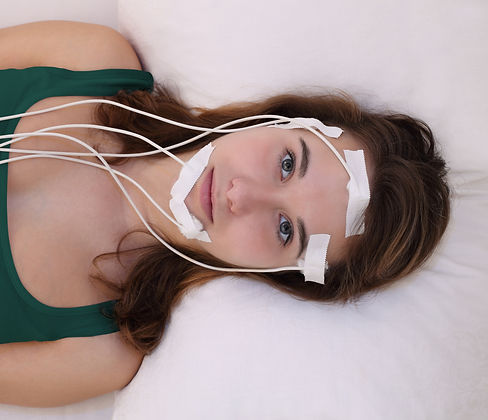
A sleep study evaluates how the brain and body function during sleep.
Depending on the type of assessment, the study may evaluate brain activity (EEG), sleep stages, transitions between sleep stages, arousal and activation patterns, breathing during sleep, autonomic nervous system function, movement, and physiological regulation.
Sleep studies help us understand not only how long a person sleeps, but also how effectively the nervous system regulates and restores itself during sleep.
Sleep plays an important role in attention and concentration, emotional regulation, learning and memory, information processing speed, nervous system recovery, and cognitive performance.
Sleep disturbances may appear as daytime fatigue, hyperactivity, difficulty concentrating, “brain fog,” irritability, emotional instability, and slowed thinking.
Sometimes these difficulties are related not only to stress or behavior, but also to how the brain organizes sleep physiology.
Sleep studies and ERP assessments are methods of functional neurophysiological evaluation and do not replace medical diagnosis.
They are used as additional tools to provide deeper insight into brain function, cognitive information processing, and nervous system regulation in both children and adults.


ERP testing
ERP (Event-Related Potentials) is a specialized EEG-based assessment that evaluates how the brain processes information in real time.
During testing:
-
EEG sensors are placed on the scalp
-
the individual performs simple cognitive tasks
-
brain responses are recorded with millisecond precision
ERP helps evaluate attention allocation, information processing speed, sensory processing, cognitive control, inhibition of impulsive responses, working memory, and executive functioning.
Different ERP paradigms evaluate different brain systems.
Auditory ERP Tests
Help evaluate:
-
auditory attention
-
stimulus discrimination
-
automatic brain responses to changes
Visual ERP Tests
Help evaluate visual processing, reaction speed, visual attention
GO / NO-GO Tasks
Help evaluate . impulse control, response inhibition, executive functioning, cognitive flexibility
The type of ERP testing is selected depending on:
-
age
-
developmental level
-
cognitive abilities
-
assessment goals
-
fatigue tolerance
This type of assessment may be especially helpful in cases involving attention difficulties, learning differences, developmental variability, sensory processing differences, and recovery after concussion or traumatic brain injury.